
Google Ads vs Facebook Ads: Cost and Performance Analysis
Explore the differences between Google Ads and Facebook Ads in terms of cost, performance, and effectiveness for your business goals.
Editorial Team
Heaviside Digital
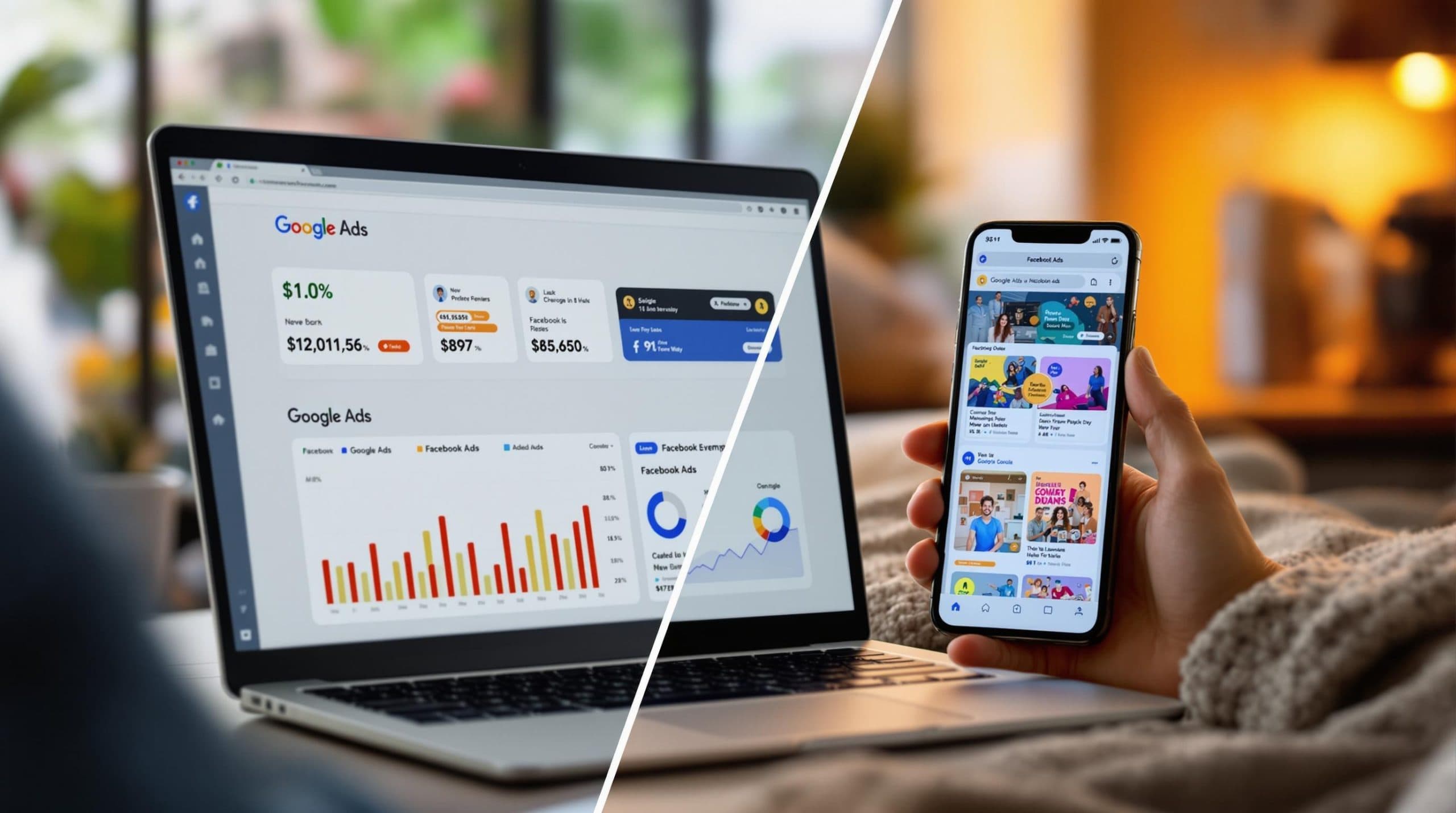
Looking to choose between and Facebook Ads? Here’s the deal:
- Google Ads targets users with high purchase intent, ideal for quick conversions. Costs average $8 per click with an 8% conversion rate.
- Facebook Ads excels at brand awareness using demographic and behavioral targeting. It’s budget-friendly at $0.70 per click, with a 3% conversion rate.
Quick Comparison
Aspect
Google Ads
Facebook Ads
Focus
Search intent
Demographics & behavior
Ad Strength
Text-based search ads
Visual and interactive
Best For
High-intent purchases
Brand awareness & loyalty
Cost Per Click
$8
$0.70
Conversion Rate
8%
3%
Takeaway: Use Google Ads for immediate sales and Facebook Ads for building long-term connections. Combining both platforms can maximize results.
[##Differences Between and Facebook Ads

Intent and Targeting
Google Ads focuses on users who are actively searching for specific solutions, while Facebook Ads uses behavioral data to spark interest and create demand. This core difference shapes how each platform performs for advertisers.
Performance data backs this up. For example, plumbing services using Google Ads saw a 25% higher conversion rate compared to their [Facebook campaigns ].
Targeting Aspect
Google Ads
Facebook Ads
Primary Focus
Search intent & keywords
Demographics & behavior
Data Source
Search queries
User profile & activity
Audience State
Active searching
Passive browsing
Best For
Immediate needs
Brand discovery
These differences in targeting also determine the types of ad placements and formats available on each platform.
Ad Placement and Formats
Google Ads integrates with user search behavior, displaying ads in search results and across its display network to address active queries. Most ads on Google are text-based.
Facebook Ads, on the other hand, provides a range of creative formats, including visual and interactive options like carousel and video ads. These formats work well for industries such as retail and fashion. For instance, a clothing brand using Facebook’s carousel ads reported a 50% boost in click-through rates and a 20% increase [in ROI ].
A study analyzing 1,000 clicks found that while Google Ads generally delivered higher conversion rates, Facebook Ads often achieved a lower cost [per conversion ].
Cost and Performance Analysis
ROI and Conversion Rates
When comparing Google Ads and Facebook Ads, each platform offers distinct advantages depending on your business goals. Google Ads tends to have higher costs but delivers more immediate results for businesses focused on direct conversions. On the other hand, Facebook Ads provides a more budget-friendly way to boost brand awareness and nurture [potential leads ].
Metric
Google Ads
Facebook Ads
Best Use Case
Direct Response
Brand Awareness
Intent Level
High
Medium to Low
The differences in how these platforms perform make them better suited for specific marketing objectives. ROI can vary widely depending on the industry and type [of business ].
Audience Reach and Scalability
To effectively scale your campaigns, it’s important to understand how each platform engages with audiences. Google Ads targets users actively searching for specific products or services, while Facebook Ads excels at generating interest through precise audience targeting. These contrasting approaches significantly impact how scalable and sustainable campaigns can be.
For example, an e-commerce brand used a dual-platform strategy – Facebook Ads for building brand awareness and Google Ads for driving conversions. This approach led to a 30% increase in ROI over just [three months ].
Targeting Options
The targeting features of each platform play a key role in determining cost efficiency and overall performance:
Google Ads:
- Prioritizes high-intent buyers using keyword and location targeting
- Focuses on audiences ready to make a purchase
Facebook Ads:
- Uses demographic and behavioral data for interest-based targeting
- Offers tools like custom audiences and lookalike modeling for precise reach
For businesses with smaller budgets, Facebook Ads often provides a lower-cost entry point. However, for those aiming to attract high-intent customers, Google Ads typically delivers better results, even with its higher cost [per click ] [].
Choosing the Right Platform for Your Business
Matching Business Goals
When deciding between Google Ads and Facebook Ads, it’s crucial to align your choice with your business goals. For high-value products or services like legal advice or real estate, Google Ads often stands out thanks to its ability to target users based [on intent ].
With platforms like and TikTok reshaping how consumers interact with ads, digital advertising continues to evolve.
Business Goal
Recommended Platform
Key Advantage
Immediate Sales
Google Ads
Targets high-intent buyers
Brand Building
Facebook Ads
Reaches a broader audience
Local Services
Google Ads
Focuses on location targeting
Product Discovery
Facebook Ads
Engages users visually
Budget Analysis
After identifying your goals, the next step is to assess your budget and how each platform fits into it.
Facebook Ads is particularly budget-friendly for small businesses, offering a mix of affordability and reach. Some of its standout benefits include:
- Lower cost-per-click rates
- Access to a wide audience
- Flexible budget options
- Advanced demographic targeting
Using Both Platforms
Combining Google Ads and Facebook Ads can help businesses cover the entire customer journey. Google Ads works well for attracting high-intent users, while Facebook Ads excels at building awareness and engaging potential customers.
"Many consumers are searching for businesses on social media first in lieu of traditional search platforms. We are seeing social platforms increasingly fill all stages in the marketing funnel, whereas search now tends to be a strategy focused on immediate conversions."
For example, a clothing brand used Facebook’s carousel ads to increase click-through rates by 50% and achieved 20% higher ROI when paired with [Google Ads ].
The secret is understanding the strengths of each platform. Google Ads is ideal for capturing leads ready to convert, while Facebook Ads helps grow your brand and maintain customer relationships through [precise targeting ] [].
sbb-itb-fa66596
Facebook vs Google Ads: Which is Best in 2024?
Conclusion and Recommendations
Deciding between Google Ads and Facebook Ads – or using both – depends on your business goals and available resources. Google Ads tends to have higher costs per click (CPC), but it’s great for attracting quality leads. On the other hand, Facebook Ads offers a cost-effective way to reach a wide audience. Knowing these differences can help you develop a smarter advertising strategy.
If your business needs quick conversions from people actively searching for your products or services, Google Ads is the way to go. It’s particularly effective for:
Business Type
Best Platform
Suggested Strategy
Service-Based
Google Ads
Focus on local keywords
E-commerce
Both Platforms
Use Facebook for awareness, Google for sales
B2B Solutions
Google Ads
Target niche, industry-specific terms
Consumer Brands
Facebook Ads
Use demographic-based targeting
For smaller businesses aiming to increase brand awareness and engage potential customers, Facebook Ads shines with its advanced targeting options and affordability. However, experimenting with both platforms can help you find the best way to spend your ad budget.
Here are some tips to make the most of your campaigns:
- Monitor Results and Adjust: Use analytics tools to track cost-per-conversion and reallocate your budget based [on performance ] [].
- Play to Each Platform’s Strengths: Use Facebook Ads for brand awareness and retargeting, while relying on Google Ads to capture high-intent [search traffic ].
- Combine for Maximum Impact: Blend Facebook’s engagement tools with Google’s ability to convert searches [into sales ].
Google Ads works well for capturing existing demand, while Facebook Ads helps create demand through engaging and [targeted content ] []. Matching the platform to your business goals and audience behavior will help you get the most out of your advertising efforts. </
FAQs
What is the conversion rate for Google Ads vs Facebook Ads?
Google Ads and Facebook Ads show different conversion rate patterns. On average, Google Ads’ search network sees a 4.40% conversion rate, while Facebook Ads averages 9.11% [across industries ]. This reflects the platforms’ distinct strengths: Google Ads is great for high-intent searches, while Facebook Ads often provides more cost-effective brand engagement.
Here’s a quick look at conversion metrics:
- Google Ads Search Network: 4.40%
- Google Ads Display Network: 0.57%
- Facebook Ads: 9. [11% ]
Although Google Ads generally comes with higher costs per click ($2.69 compared to Facebook’s $1.68), its success depends heavily on factors like your industry and [campaign goals ]. Conversion rates can fluctuate due to:
- Industry competition
- Ad quality and relevance
- How well the audience engages
- Seasonal trends
- Location targeting
To get the most out of your campaigns, focus on your own metrics rather than relying solely on [industry benchmarks ]. Experiment with both platforms to determine which one delivers the best ROI for your business. Google Ads often drives immediate conversions, while Facebook Ads can help you reach a larger audience at a lower cost.
Related Blog Posts
- (/blog/seo-vs-ppc-which-digital-marketing-strategy-fits-your-business)
- (/blog/social-media-marketing-guide-for-small-business-success)
- (/blog/top-6-digital-marketing-tools-for-small-businesses)
- (/blog/advanced-hyperlocal-social-media-strategies-for-2024)
Share this article
Help others discover this content
About Heaviside Digital
We help local businesses get found in search and make it easier for a website visitor to contact them. Our work also covers advertising and the follow-up that turns a new lead into a conversation.
Learn more about usContinue Reading
What a Local Rank Grid Actually Tells You About Google Maps
One map ranking can look fine while most of your service area cannot find you. Learn how to read a local rank grid and choose the next action.

How to Use AI Tools to Save Time on Marketing Without Losing Your Voice
Discover how digital marketing agencies can harness AI to draft campaign copy and repurpose client wins faster without producing bland, cookie-cutter content that alienates prospective clients.
Answer Engine Optimization — The SEO Strategy Nobody Is Talking About Yet
For agencies helping local brands scale, traditional SEO tactics are missing half the equation. Dive into Answer Engine Optimization (AEO) tailored for digital marketing firms, and learn how to optimize your agency's online presence to be cited directly by ChatGPT and Google Overviews.